
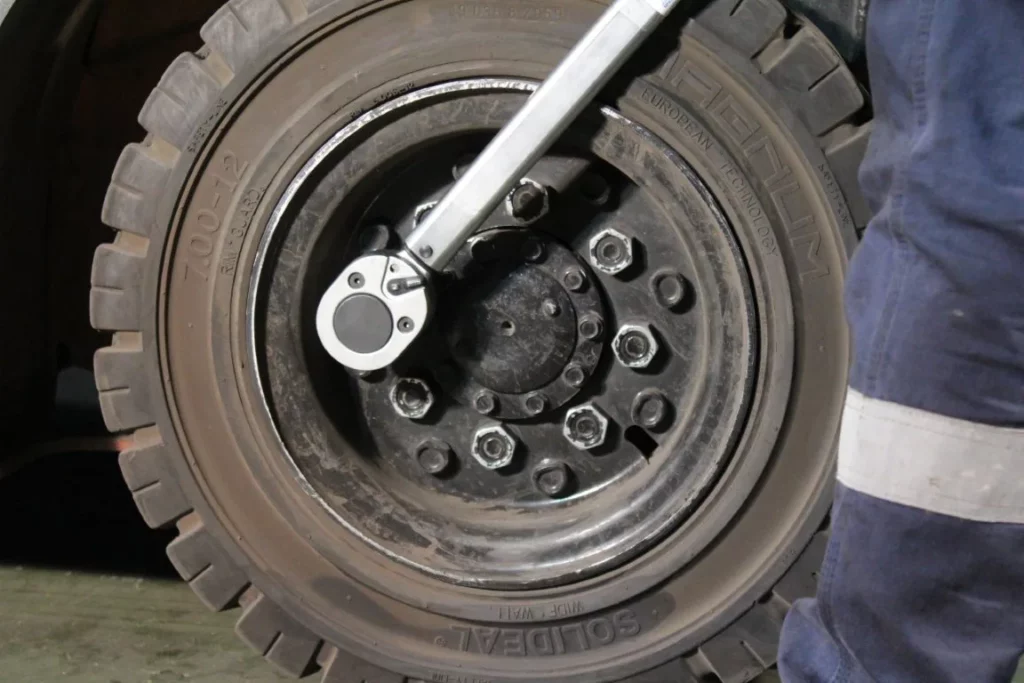
Replace your forklift tyres when you see chunking on the tread surface, flat spots from extended stationary parking, sidewall cracking or splitting, tread depth below the safe wear line, heat cracking from overloading or extended shift use, or visible rim damage caused by tyre degradation. Any one of these signs is a reason to take the machine out of service until the tyres are replaced. Running past these indicators isn’t a cost-saving decision: under the OHS Act, your obligation as a South African employer is to maintain driven plant in a safe condition, and worn forklift tyres that cause an incident put that obligation squarely in focus.
This guide covers each warning sign in detail, what the OHS Act actually requires, how long forklift tyres typically last under different operating conditions, and what the process for replacement looks like.
What does the OHS Act say about forklift tyre maintenance in South Africa?
The Occupational Health and Safety Act (Act 85 of 1993) and its Driven Machinery Regulations (Regulation 18) place a direct duty of care on employers to ensure that driven plant, which includes forklifts, is maintained in a safe working condition. The regulations require that all machinery used in the workplace is operated and maintained so as not to expose persons to hazards.
Worn forklift tyres create several clearly foreseeable hazards: reduced load stability, increased stopping distances, loss of traction on wet floors, reduced steer response and the risk of a tyre separating or delaminating during operation.
An insurance claim following a forklift incident will routinely include an inspection of the machine’s maintenance records. A forklift found to have been operating on tyres showing visible wear beyond safe limits is a significant liability exposure for the employer, not just a safety issue. Workplace inspectors from the Department of Employment and Labour can issue a prohibition notice against a machine or an entire operation if equipment is found to be in an unsafe condition.
Practically speaking, replace tyres when the indicators below appear. Don’t manage them down to the last millimetre.
The six warning signs that it’s time to replace forklift tyres
1. Chunking on the tread or body
Chunking is the most common wear pattern on solid and pneumatic forklift tyres operating on rough surfaces. It shows as pieces of rubber missing from the tread face or the body of the tyre, often in a roughly rectangular shape. Small chunks on the tread surface are manageable in the short term, but chunking that exposes the internal layers of the tyre or that is accelerating between inspections means the tyre needs to come off now.
Chunking that happens quickly after a new tyre is fitted usually points to a surface or application mismatch rather than a tyre quality issue. If you’re seeing heavy chunking on solid tyres in what should be a warehouse environment, check whether the machine is being used on surfaces it wasn’t specified for.
2. Flat spots from extended stationary parking
A forklift left parked for several days or weeks with the full load of the machine resting on the same point develops flat spots where the tyre’s compound has taken a permanent set. On solid tyres this shows as a visible flattened area on the tread; on pneumatic tyres it’s more obvious because the deflation is visible.
Mild flat spots on solid tyres often work themselves out during normal operation. Severe flat spots that cause the machine to bounce or vibrate noticeably during travel don’t recover and the tyre should be replaced. Running a machine on severe flat spots accelerates wear on the axle bearings and the drive train, adding cost beyond the tyre itself.
3. Sidewall cracking or splitting
Sidewall cracking in solid tyres is caused by oxidation and ozone exposure of the rubber compound over time, accelerated by UV exposure, heat cycling and the specific rubber chemistry of the tyre. Surface cracking that looks like fine lines across the sidewall is normal ageing. Cracks that are deep enough to put a fingernail into, or that show any sign of the rubber separating, are not.
In KwaZulu-Natal specifically, the coastal environment accelerates rubber ageing through a combination of high humidity, salt air and UV intensity. If your forklifts sit outdoors or near open warehouse doors, tyre life is shorter than it would be in a controlled indoor environment.
4. Tread depth below the wear line
Most solid forklift tyres have a wear indicator moulded into the tyre body, either a groove or a small raised marker. When the tread surface wears down to this indicator, the tyre has reached the end of its designed service life. Some operators try to run past this point. The wear indicator is there for a reason: the compound properties of the tyre change as it wears deeper into the body, and the load-carrying capacity, heat dissipation and stability characteristics all deteriorate.
If the tyre you’re running doesn’t have a visible wear indicator (some entry-level imports don’t), a useful rule of thumb is to replace solid tyres when the tread depth reaches approximately 50% of the original tread depth. Call us if you’re unsure: bring the machine in or send us a photo and we’ll give you a straight assessment.
5. Heat cracking from overloading or multi-shift use
Solid forklift tyres generate internal heat during use. This is normal and the compound is designed to handle a certain heat load. When a machine is consistently overloaded beyond its rated capacity, or when tyres are used across very long shifts without adequate rest, the heat generated exceeds the compound’s tolerance and you start seeing heat cracking: cracking that radiates from the tyre body outward, often starting around the rim interface.
Heat cracking is a serious indicator. It means the structural integrity of the tyre is compromised, not just the surface. A tyre showing heat cracking should come off the machine immediately.
6. Rim damage from tyre degradation
When a solid tyre wears past its service life on the rim, the rubber compound starts to lose its grip on the steel band (for press-on tyres) or the bead seat (for resilient and cushion tyres). The first signs are usually visible movement of the tyre on the rim, rubber debris around the rim interface, and in advanced cases, damage to the rim itself.
Running a tyre in this condition can result in the tyre coming off the rim during operation. Replace the tyre before you get to this point. If the rim is already damaged, it needs to be assessed before a new tyre is fitted: a damaged rim can cause a correctly fitted tyre to seat incorrectly, which creates the same movement problem again.
How long do forklift tyres last in South Africa?
Service life varies significantly depending on the tyre type, compound grade, operating surface, shift intensity and the specific operating environment.
Solid tyres in standard indoor warehouse use (one shift per day): A mid-tier to premium compound solid tyre in a standard distribution centre or warehouse, running one eight-hour shift per day on sealed concrete, typically delivers 2,500 to 4,000 operating hours before reaching the wear indicator. At 250 operating days per year and 8 hours per shift, that’s roughly 1.25 to 2 years of service.
Solid tyres in multi-shift or heavy-duty use: The same tyre running two shifts per day on a heavy machine with frequent lifts will deliver significantly fewer calendar months even if the operating hours are similar, because the heat cycling is more intense. Budget for replacement cycles of 10 to 16 months on high-utilisation operations.
Solid tyres in KZN coastal environments: Coastal conditions in Durban and the surrounding areas accelerate rubber ageing and compound degradation. Tyres that would last 24 months in a Johannesburg inland warehouse may show signs of surface cracking at 18 months in a Durban facility near the coast. This is a real effect that affects both service life and the appearance of ageing indicators. Sidewall cracking in particular tends to appear earlier in coastal operations.
Pneumatic tyres on outdoor or rough-terrain work: Air-filled pneumatic tyres on construction sites, port operations and agricultural applications typically last 1,000 to 2,500 operating hours, depending heavily on the surface and the frequency of punctures. Solid-fill pneumatics deliver service lives closer to solid tyres on similar applications.
Cushion tyres on smooth indoor concrete: Cushion tyres on the right surface can deliver very long service lives, sometimes exceeding 4,000 hours, because the smooth floor generates less abrasion than a typical warehouse concrete surface with expansion joints, pallet debris and traffic.
Should you replace all four tyres at once?
Not always, but think carefully before replacing fewer than the full set on a machine.
Forklift tyre wear is not perfectly even across all four positions on most machines. The driven and steered rear tyres typically wear differently from the load-carrying front tyres. Running one new tyre alongside three tyres that are significantly further worn can create handling imbalances, particularly on tight turns.
A sensible approach is to replace the axle pair together: replace both front tyres at the same time, and both rear tyres at the same time, even if the wear on one tyre in a pair is slightly ahead of the other. This keeps each axle balanced.
If one tyre has been damaged or has failed ahead of its expected service life, a single tyre replacement is fine, provided we can match the compound grade to what’s still on the machine.
What happens if you don’t replace worn forklift tyres?
Beyond the OHS Act liability already covered above, the practical consequences escalate the longer worn tyres remain in service.
Worn tyres reduce load stability, which increases tip-over risk. On rack operations, reduced traction from worn tyres increases the chance of the machine sliding rather than stopping cleanly under load. Vibration from flat-spotted or chunked tyres accelerates wear on the machine’s drivetrain, steering components and mast assembly.
In our experience, operations that manage tyres proactively spend less on both tyres and forklift maintenance overall. The operations that run tyres as long as possible tend to have higher total costs when you account for the machinery repairs that come with it.
Frequently asked questions
How do I know when to replace forklift tyres if there’s no obvious visible wear? Track operating hours and set a replacement inspection at a fixed interval based on your machine’s utilisation. For a one-shift warehouse operation, a tyre inspection every 1,000 operating hours is a reasonable starting point. If you’re not tracking hours, a calendar-based inspection every six months is a reasonable fallback. We can assess the tyre condition and give you a remaining-life estimate.
Can worn forklift tyres cause a forklift to tip over? Yes. Worn tyres reduce the machine’s stability envelope, particularly on turning manoeuvres under load. The reduction in traction means the machine can slide rather than turn cleanly, and the reduced rubber mass affects the suspension effect that tyres provide even on solid-type tyres. Tyre condition is one of the factors assessed in a forklift stability investigation following an incident.
Is there a legal minimum tread depth for forklift tyres in South Africa? The OHS Act and Driven Machinery Regulations don’t specify a minimum tread depth in millimetres. The requirement is that the machine is maintained in a safe operating condition. Whether a specific tyre at a specific wear level meets that standard is a matter of judgement. The manufacturer’s wear indicator is the clearest available standard to follow. If the indicator is reached, replace the tyre.
How often should forklift tyres be inspected? A visual inspection at the start of every shift is good practice and is consistent with the OHS Act’s requirements for pre-use checks on driven plant. A more detailed inspection by someone who knows what to look for should happen at least monthly, and every time a machine comes in for servicing.
Does ForknTire do tyre assessments without committing to a sale? Yes. If you’re unsure whether your tyres need replacing, bring the machine to our Pinetown workshop or send us clear photos of each tyre. We’ll give you an honest assessment. We’re not in the business of selling tyres that don’t need replacing. We’re in the business of building long-term supply relationships with industrial operators.
How quickly can ForknTire replace tyres once I’ve decided to go ahead? For standard sizes that we carry in stock, often within the same day or the following business day. For sourced sizes, a few days. Call us on 031 702 6335 to check stock and confirm a realistic timeframe for your specific size.
Get a tyre condition assessment or a replacement quote
If any of the signs above are showing on your machines, contact us before the next operating shift. We’re at 6 Schenk Road in Pinetown and we’ve supplied and fitted industrial tyres across South Africa since 2008. Call 031 702 6335 or email forkntire@telkomsa.net.
We offer on-site assessments across KwaZulu-Natal and on-site fitting where the machine can’t be transported. For most standard solid tyre sizes, workshop fitment is available on short notice.
ForknTire is a specialist industrial tyre supplier and fitter based in Pinetown, Durban. We supply solid, pneumatic, cushion and non-marking forklift tyres to operations across South Africa and can provide maintenance advice, tyre condition assessments and replacement scheduling support.