
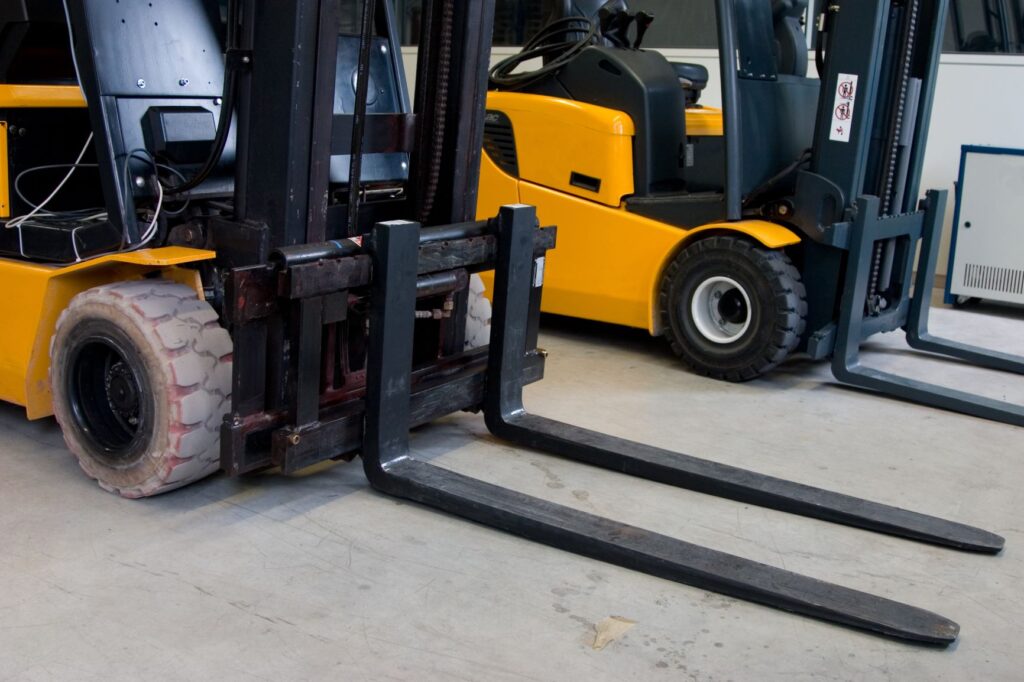
Forklift tyre sizes follow two main formats. The first looks like 7.00-12 or 6.50-10: the first number is the tyre width in inches, the second is the rim diameter in inches. The second format looks like 28×9-15 or 21×8-9: width x cross-section height x rim diameter. If you know which format your machine uses and can find the numbers on the data plate, you have everything needed to order the correct replacement tyre.
The numbers matter more than most buyers realise. An incorrect tyre size affects the forklift’s load rating, its ground clearance, its turning geometry and in some cases the safety certification of the machine. This guide explains both size formats, how to find the size information on your machine, and what to do when the data plate is missing or illegible.
Where to find the correct tyre size for your forklift
Every forklift has a data plate that specifies the correct tyre size. The location varies by make and model, but common positions are:
- On the mast, usually on the lower section of the inner mast channel
- On a panel inside the cab or operator compartment, near the dashboard
- On the overhead guard strut or crossbar
- On the chassis near the front axle
The data plate includes the machine’s model number, serial number, load capacity, load centre distance and tyre specification. The tyre size listed is the manufacturer’s recommended fitment for that specific machine configuration. Don’t rely on what the machine is currently running if you’re not certain it’s had the correct size fitted previously.
If the data plate is present but the tyre size section is worn or partially illegible, the model number and serial number are enough to cross-reference the correct specification. We keep manufacturer reference data for Toyota, Komatsu, Mitsubishi, Nissan/Unicarriers, Hyster, Crown, Linde, Yale, Clark, Doosan, JCB and most other brands commonly used in South Africa.
How to read the first forklift tyre size format (width-rim)
The format 7.00-12 breaks down as follows:
7.00 = tyre section width in inches This is the width of the tyre cross-section, measured at the widest point when the tyre is correctly inflated or fitted. On solid tyres this is simply the width of the rubber.
12 = rim diameter in inches This is the diameter of the rim that the tyre mounts onto, not the overall diameter of the tyre.
So 7.00-12 means: a tyre with a 7-inch section width designed to fit a 12-inch rim.
Other common sizes in this format you’ll encounter on South African forklifts:
| Size | Width (inches) | Rim diameter (inches) | Common application |
|---|---|---|---|
| 5.00-8 | 5.0 | 8 | Compact 1-tonne electric forklifts |
| 6.00-9 | 6.0 | 9 | Small counterbalance and reach trucks |
| 6.50-10 | 6.5 | 10 | Light-duty electric and gas forklifts |
| 7.00-12 | 7.0 | 12 | Standard 1.5 to 2.5-tonne forklifts |
| 8.25-12 | 8.25 | 12 | 2.5 to 3-tonne counterbalance forklifts |
| 8.25-15 | 8.25 | 15 | Heavier counterbalance forklifts and reach trucks |
| 9.00-20 | 9.0 | 20 | Large pneumatic tyres on outdoor forklifts and telehandlers |
How to read the second forklift tyre size format (width x height x rim)
The format 28×9-15 breaks down as follows:
28 = overall tyre diameter in inches This is the outside diameter of the complete tyre when fitted to the rim.
9 = tyre section width in inches
15 = rim diameter in inches
This format is used predominantly for solid press-on tyres where the overall mounted diameter is a critical specification because it affects the machine’s lift height and clearance. If the overall diameter changes, the forklift’s load backrest height and fork height at various mast positions all change with it.
Common sizes in this format on South African forklifts:
| Size | Overall diameter | Width | Rim diameter | Common application |
|---|---|---|---|---|
| 21×7-15 | 21″ | 7″ | 15″ | Medium counterbalance forklifts |
| 21×8-9 | 21″ | 8″ | 9″ | Standard warehouse counterbalance |
| 23×9-10 | 23″ | 9″ | 10″ | Mid-range counterbalance forklifts |
| 28×9-15 | 28″ | 9″ | 15″ | Standard 2.5 to 3.5-tonne forklifts |
| 250-15 | 25″ | 10″ | 15″ | Heavy-duty counterbalance forklifts |
Solid tyre sizes vs pneumatic tyre sizes: are they interchangeable?
No. The size code format may look similar but solid and pneumatic tyres are not interchangeable, even when the numbers appear to match.
A solid tyre in size 7.00-12 and a pneumatic tyre in size 7.00-12 are built on completely different constructions. The solid tyre is dense rubber throughout; the pneumatic has a fabric-reinforced casing around an air chamber. They mount differently, have different rim requirements and place different loads on the axle.
Your data plate will specify not just the size but the tyre type. Check both before ordering. If the data plate specifies solid (sometimes abbreviated as “SE” for solid-resilient or “PR” for press-on), don’t fit a pneumatic of the same dimensional size and vice versa.
What does “non-marking” or “NM” mean on a tyre spec?
Some data plates or fitment records note “NM” or “non-marking” as part of the tyre specification. This doesn’t change the size; it specifies the compound type. Non-marking tyres of the same size as a standard tyre fit the same rim and have the same dimensional specification. The difference is in the rubber compound, which contains no carbon black and therefore leaves no black marks on clean floors.
If your current fitment is non-marking and you’re ordering replacements, make sure to specify non-marking when you order. A standard tyre of the same size will fit and function correctly but will leave black marks on the floor if your operation requires a clean-floor environment.
What to do when the data plate is missing or the tyre size is worn off
This happens more often than it should, particularly on older machines, machines that have changed hands multiple times or machines that have been repainted. If you’re looking at a forklift with no legible data plate, here’s how to find the correct tyre size.
Option 1: Use the machine’s model number and serial number Even without the data plate, the model number is usually stamped or cast into the chassis in a location that’s less exposed to wear. The serial number is similar. Give us both numbers and we’ll cross-reference the manufacturer specification. This is reliable for most makes and models in our reference system.
Option 2: Measure the existing tyre If the existing tyre is still on the machine and is a type with a readable size marking, measure it or locate the moulded size code on the tyre sidewall. Most tyres have their size moulded into the sidewall rubber, though on heavily worn tyres this can be difficult to read. Note that if the machine has been running an incorrect size previously, measuring the current tyre won’t necessarily give you the right specification.
Option 3: Bring the machine in for assessment We can identify the correct tyre specification from a physical inspection of the machine. If you’re in the Durban area, bring the forklift to our Pinetown workshop at 6 Schenk Road and we’ll sort it out in person.
Option 4: Contact the machine’s dealer or manufacturer For machines still under warranty or recently purchased from a dealer, the dealer should have the specification on record. For older machines, the manufacturer’s South African importer (most have one for Toyota, Komatsu, Mitsubishi, Hyster and the other major brands) can usually provide the spec from the serial number.
Why using the wrong tyre size is a problem
Getting the tyre size wrong isn’t just a fitment inconvenience. The implications are practical and legal:
Load rating: Forklift load ratings are certified for a specific tyre size. A tyre that’s wider or taller than spec changes the machine’s stability triangle and can affect the certified load capacity.
Ground clearance: An oversized tyre raises the machine’s ride height, which affects the fork height at every mast position. This can cause clearance problems in racking aisles and can affect the safe lifting height under overhead structures.
Turning radius: A wider-than-spec tyre in a narrow aisle warehouse changes the turning radius and can make the machine unsafe to operate in the space it was specified for.
OHS Act compliance: A forklift with incorrectly specced tyres is technically not being operated as its manufacturer certified it, which has implications under the Driven Machinery Regulations if an incident occurs.
Frequently asked questions
The size on my tyre sidewall is different from the data plate. Which one should I follow? Follow the data plate. The data plate reflects the manufacturer’s specification for that machine. If the existing tyre is a non-standard size, it was either fitted incorrectly at some point or the machine has been modified. Either way, revert to the data plate specification when ordering replacements.
My forklift has two different tyre sizes front and rear. Is that normal? Yes, this is standard on many counterbalance forklifts. The front (load-carrying) tyres are typically larger than the rear (steering) tyres. Both sizes will be on the data plate. Make sure you’re ordering the right size for each axle position.
What does the letter after the size number mean, like 7.00-12/10PR? The “10PR” indicates ply rating, which is relevant mainly for pneumatic tyres. It refers to the strength rating of the tyre casing (originally a literal count of fabric plies, now a rating derived from the equivalent strength). Higher ply ratings indicate stronger casings suitable for heavier loads. On solid tyres, you may see compound grade letters or codes instead.
Can ForknTire source unusual or older tyre sizes? We stock the most common sizes across our range and can source less common sizes. If you’re working with an older or less common machine, call us with the size and machine details. We’ll confirm availability and a realistic lead time.
Need help identifying the right tyre for your machine?
Call us on 031 702 6335 or email forkntire@telkomsa.net with your machine’s make, model number, serial number and any information you can find on the data plate. We’ll confirm the correct size, check stock availability and give you a price within the same day in most cases.
We’re at 6 Schenk Road in Pinetown and we’ve been cross-referencing tyre specs to machines across South Africa since 2008.
ForknTire stocks and fits forklift tyres across the major size ranges used on South African industrial equipment. We stock tyres for Toyota, Komatsu, Mitsubishi, Nissan, Hyster, Crown, Linde, Yale, Clark, Doosan, JCB, Yanmar, TCM, Hyundai and other brands. Call 031 702 6335 or visit our Pinetown workshop.