
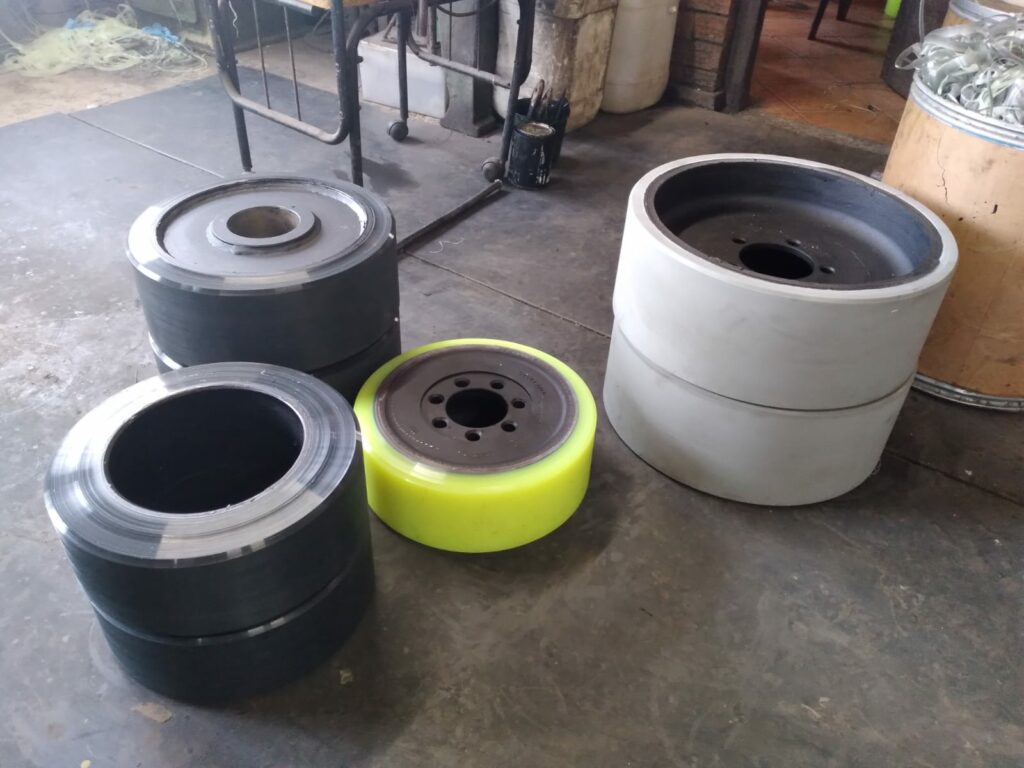
Non-marking forklift tyres are solid or cushion tyres made without carbon black in the rubber compound. This gives them a white or grey colour and means they don’t leave black tyre marks on clean floors. They’re required in any environment where floor contamination is a regulatory or operational issue: food processing and packaging facilities, pharmaceutical warehouses, automotive OEM plants and clean-floor retail distribution centres are the most common applications in South Africa. If your industry operates under FSSC 22000, ISO 22000 or similar food safety and hygiene standards, you almost certainly need non-marking tyres on any forklift working inside the production or packing area.
We stock non-marking solid and cushion tyres at our Pinetown workshop in the most common sizes used on South African industrial equipment.
What makes a forklift tyre leave black marks?
Standard forklift tyres are black because the compound contains carbon black. Carbon black is added to the rubber formulation to reinforce the compound, increase abrasion resistance, extend service life and improve heat dissipation. It does all of these things extremely well, which is why it’s been the dominant rubber reinforcement agent in tyre manufacturing for over a century.
The problem is that carbon black particles transfer to the floor when the tyre scrubs, scuffs or slides. On a clean warehouse floor, this shows as black skid marks. On a sealed production floor in a food facility, it’s a contamination risk.
Non-marking tyres replace the carbon black with alternative reinforcement compounds, typically silica-based or other proprietary formulations. This eliminates the floor marking problem and preserves as much of the performance and durability of a standard tyre as the formulation allows. The trade-off is that the alternative compounds don’t quite match the performance of carbon black across the board, which is why non-marking tyres have a slightly shorter service life and cost more per tyre than equivalent standard compound tyres.
Which industries in South Africa require non-marking forklift tyres?
Food manufacturing and packaging This is the largest application segment for non-marking tyres in South Africa. Any forklift operating inside a production facility, a packing line or a hygienic storage area is expected to run non-marking tyres if the facility operates under food safety certification. Facilities certified under FSSC 22000 (Food Safety System Certification), ISO 22000, HACCP principles or the South African Department of Agriculture’s requirements for export food facilities will be audited on this, and tyre type in the production area is a visible check item.
Major food manufacturing operations along the KZN south coast and in the South Durban Basin corridor, as well as Gauteng’s food processing hub in the East Rand and Johannesburg south, account for a significant part of our non-marking tyre supply.
Pharmaceutical warehousing and distribution Pharmaceutical cold chain and ambient storage facilities in South Africa operate under SAHPRA (South African Health Products Regulatory Authority) guidelines that require controlled, clean storage environments. Forklifts inside the storage area need non-marking tyres. Third-party logistics operators handling pharmaceutical products for major principals are held to the same standard.
Automotive original equipment manufacturing The automotive OEM plants in the Eastern Cape (Gqeberha/Port Elizabeth) and KwaZulu-Natal (Tshwane and surrounding areas) operate forklift fleets inside assembly buildings on painted or sealed floors. Non-marking is a site rule at these facilities rather than a regulatory requirement per se, but the supply chain audit obligations that apply to tier-1 suppliers mean the rule flows down to contract logistics operators working within the same buildings.
Retail and FMCG distribution centres Large retail distribution centres for grocery and FMCG brands apply non-marking requirements in areas where floor cleanliness is a brand standard and where consumer product packaging is handled. Clean forklifts and clean floors are part of the operational standard in these environments.
Clean room and electronics manufacturing Less common in South Africa’s current industrial profile, but electronics assembly and precision engineering operations where particulate contamination is controlled apply non-marking tyre requirements to forklifts operating inside the controlled area.
What are the trade-offs with non-marking tyres?
Non-marking tyres are not the right choice for every forklift, even in environments that have some clean-floor areas. Understanding the trade-offs helps you make a sensible specification decision rather than applying non-marking across an entire fleet when it’s only necessary in specific areas.
Shorter service life The compound alternatives to carbon black don’t match its abrasion resistance and heat dissipation properties. Depending on the specific formulation and the operating conditions, non-marking tyres typically deliver 15% to 30% fewer operating hours than a comparable standard compound tyre from the same manufacturer and grade tier. On light-duty, one-shift-per-day applications this difference may be acceptable. On heavy, multi-shift operations it becomes a meaningful cost factor.
Higher unit price Non-marking tyres cost more to produce than standard tyres of the same size, and this is reflected in the price. Expect to pay 20% to 40% more per tyre compared to an equivalent standard compound tyre. When you combine the higher unit price with the shorter service life, the cost per operating hour for non-marking tyres is meaningfully higher than for standard tyres. This is a fixed cost of operating a compliant facility in the relevant industries; budget for it accordingly.
Limited application range Non-marking tyres are designed for clean, smooth floor environments. They are solid tyres and cushion tyres used indoors. They are not available in pneumatic formats for outdoor use (if you need outdoor traction without floor marking, that’s a different operational problem). Running non-marking tyres on rough surfaces or outdoors will reduce their service life more dramatically than the standard trade-off figures above suggest.
Appearance changes with use Non-marking tyres start as white or light grey. Over time and with use, they pick up surface contamination and take on a grey or yellowish appearance. This is cosmetic and doesn’t affect performance. In a food facility where the tyre colour matters visually for audit purposes, you may need to clean tyres more frequently or replace them earlier for presentation reasons.
What sizes do non-marking forklift tyres come in?
Non-marking solid tyres are available in most of the standard forklift tyre sizes used in South Africa, though the range is more limited than standard black compound tyres. The most common sizes in stock at our Pinetown workshop cover the small to medium electric forklift range where non-marking is most often needed:
- 6.00-9 (compact electric counterbalance forklifts)
- 6.50-10 (light-duty electric forklifts and reach trucks)
- 7.00-12 (standard warehouse electric forklifts)
- 8.25-12 (medium electric and gas counterbalance forklifts)
- 21×7-15, 21×8-9, 28×9-15 (press-on solid formats for larger machines)
Sizes outside this range are available on order. Lead times for sourced non-marking sizes are typically 5 to 10 business days depending on the size and current stock levels from our suppliers.
Non-marking cushion tyres are also available in the standard cushion tyre sizes fitted to smaller electric counterbalance forklifts.
Can you tell if a tyre is non-marking just by looking at it?
Generally yes. Non-marking forklift tyres are white or light grey when new. Standard forklift tyres are black.
The colour difference is reliable when the tyres are new or lightly used. On heavily used tyres, surface contamination can make a non-marking tyre look considerably darker. If you’re taking over management of an operation and you’re not certain what’s on the machines, the best approach is to get the fitment history from the previous manager or to replace the tyres with correctly specified product.
Don’t attempt to verify non-marking status by pressing the tyre against a clean white surface and checking for marks: this isn’t a reliable test because surface contamination on the tyre will produce marks even on a genuine non-marking tyre, and a mildly worn standard tyre may not mark visibly on a single light contact. If you need certainty, check the compound code on the tyre sidewall or the fitment record.
Frequently asked questions
Do I need non-marking tyres on all forklifts in a food facility, or just those inside the production area? Typically only those inside the production, packing or hygienic storage area. Forklifts that operate exclusively in a raw materials receiving yard, an outdoor cold store approach area or a general warehouse that doesn’t connect to the production area may not require non-marking tyres. Check your food safety audit checklist and your certification body’s specific requirements for your facility. The zoning in your HACCP plan usually defines where non-marking is required.
Will non-marking tyres completely eliminate black marks on the floor? They eliminate the carbon-black transfer marks that standard forklift tyres leave. They don’t eliminate all possible tyre-related marks: a non-marking tyre that skids across a wet floor can leave a grey or dull mark from the rubber compound itself, and accumulated surface contamination on a non-marking tyre can transfer to the floor in the same way. Non-marking tyres are not magic; they’re a specific compound choice that removes the carbon contamination risk.
Are non-marking tyres safe to use on wet floors? Yes, non-marking solid and cushion tyres perform on wet sealed floors similarly to standard solid and cushion tyres. Neither type is designed for heavy water exposure or standing water. If your facility has significant floor wash-down in operating areas, that’s a separate traction and safety question that we can advise on.
How do I specify non-marking when ordering tyres from ForknTire? When you contact us with your tyre size and machine details, just specify “non-marking” or “NM.” We’ll confirm stock, price and lead time for the non-marking compound in your size.
Does ForknTire fit non-marking tyres on-site? Yes. Press-on solid tyre fitment, including non-marking, requires a hydraulic press and is done at our Pinetown workshop. For operations that can’t transport machines, we can discuss logistics options. Contact us at 031 702 6335 to plan the fitment.
Order non-marking tyres for your operation
If you operate in a food, pharmaceutical, clean-room or automotive OEM environment in KwaZulu-Natal or anywhere in South Africa, and you need non-marking tyres, call us on 031 702 6335 or email forkntire@telkomsa.net.
Give us your forklift make, model number and the number of machines you need to fit. We’ll confirm the correct size, check stock and get you a price.
We’re at 6 Schenk Road in Pinetown and we’ve been supplying specialist industrial tyres across South Africa since 2008.
ForknTire supplies non-marking solid and cushion forklift tyres in KwaZulu-Natal and nationally across South Africa. We stock the most common sizes for electric counterbalance forklifts, reach trucks and order pickers and can source additional sizes on request. Call 031 702 6335 for stock availability and pricing.